
Complaints reported to the organization remain at an all-time high, slight increase recorded in Greater Philadelphia Region
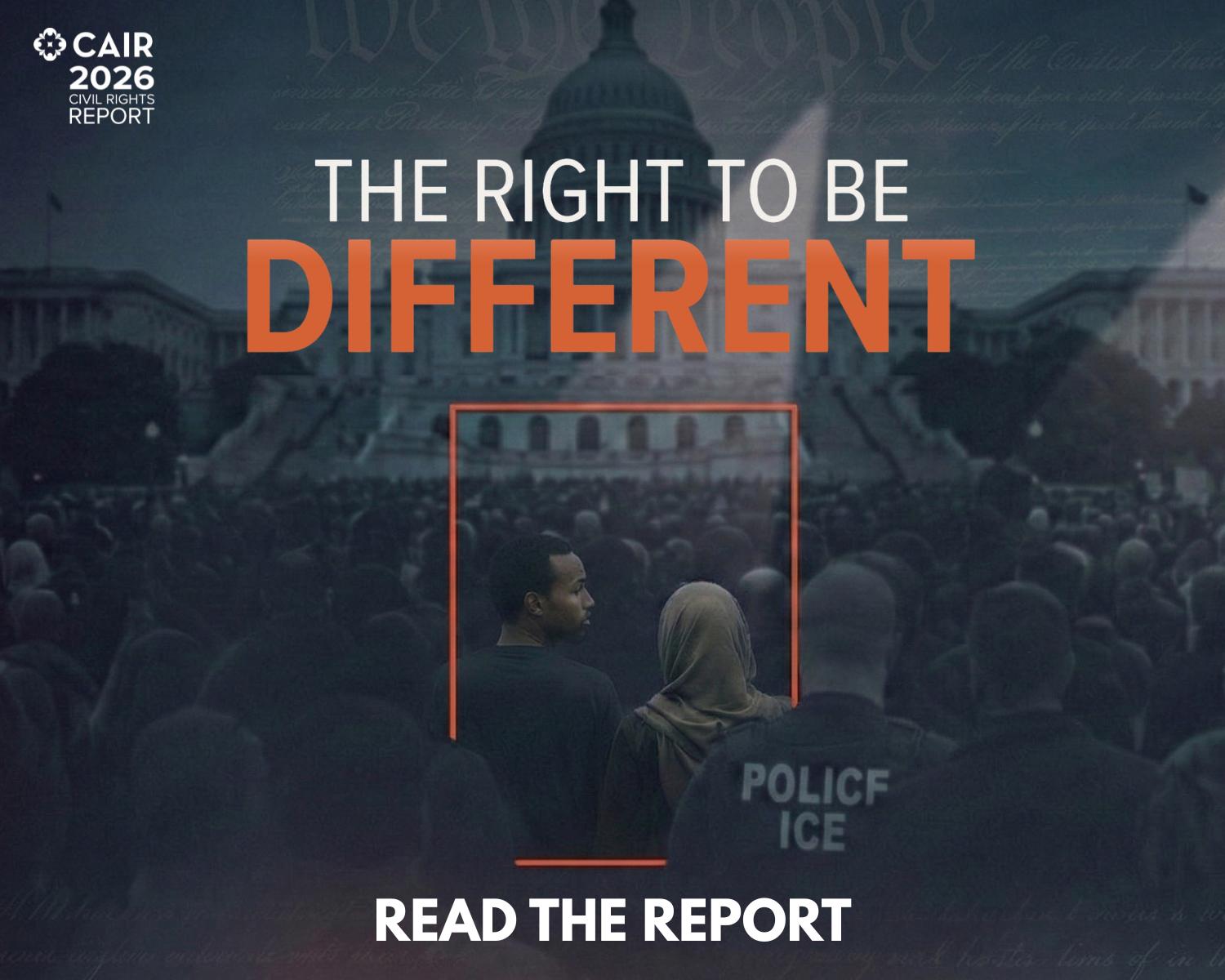
(PHILADELPHIA, PA – 3/10/2026) – The Philadelphia chapter of the Council on American-Islamic Relations (CAIR-Philadelphia) today announced the publication of CAIR’s 2026 Civil Rights Report, titled “The Right to Be Different,” documenting a pattern of public officials using their offices to narrow the definitions of what Americans can look like, say, or believe in during 2025.
WATCH: CAIR 2026 Civil Rights Report News Conference
READ: CAIR’s 2026 Civil Rights Report, “The Right to Be Different”
In a statement, CAIR Research and Advocacy Director Corey Saylor said:
“In 2025, powerful public officials argued—explicitly or by implication—that ‘freedom’ means the right to be like them: to speak the approved lines, worship the approved way, and trace ancestry to approved places. Protecting the right to be different is not a favor to any one community. It is the operating system of a free country.”
Adam Attia, Legal Director of CAIR-Philadelphia, said the national trends outlined in the report are reflected in the cases the organization is seeing locally:
“At CAIR-Philadelphia we saw a steady flow of intakes and slightly higher numbers – 222 legal intakes in 2025 – compared to 2024 numbers. The trends documented in this report mirror what we are hearing from Muslim families, students, and workers across Pennsylvania. We continue to see individuals singled out because of their faith, their advocacy for human rights, or simply their identity. Our community should not have to choose between exercising their constitutional rights and feeling safe in their schools, workplaces, and public spaces. CAIR-Philadelphia will continue using every tool available—from legal advocacy to community education—to ensure those rights are protected.”
CAIR’s research staff identified five key trends in the report:
Record complaints nationwide.
Florida, Illinois, Minnesota, Oklahoma, and Texas were national standouts in a record-setting year. Each of these states has seen an increase in complaints over the last three years. CAIR received 8,683 complaints nationwide in 2025, the highest number of single-year complaints the organization has recorded since its first civil rights report was published in 1996. This represents a 0.3% increase from the 8,658 complaints reported in 2024. CAIR Minnesota reported 693 complaints in 2025, a 96% increase over 2024, with 23% of its yearly total recorded in December. CAIR Chicago reported 877 complaints in 2025, 65% more than in 2024.
Anti-Muslim narratives resurfaced more openly in 2025.
The report documents renewed claims that Muslim religious beliefs are inherently threatening or anti-American. In 2025, extreme policies that would effectively ban the practice of the world’s second-largest religion in the United States—or the entry of its adherents into the country—were proposed, including five bills at the federal level (for example, H.R. 5512). By February, Texas Governor Greg Abbott was instigating a campaign against Muslim life in Texas while claiming he had banned sharia. In December, Reps. Chip Roy (R-TX) and Keith Self (R-TX) founded the “Sharia-Free America Caucus.” As of late February 2026, they claimed 45 members. Member remarks make clear that Islam is the target of the caucus’ work.
Government officials used collective and ideological punishment.
The report documents cases in which both non-citizens and citizens were targeted because they were perceived to be ethnically or ideologically undesirable. Three Muslim-majority groups—Afghans, Somalis, and Syrians—were specifically identified. The report also notes efforts to frame speech supporting Palestinian human rights as inherently threatening, leading to high-profile detentions and investigations.
Discretionary powers replaced normal civil rights safeguards.
A defining feature of 2025 was the increased use of discretionary authority—including executive proclamations, emergency powers, immigration discretion, regulatory investigations, and funding conditions—to achieve outcomes that would likely fail under traditional evidentiary or judicial scrutiny.
Constitutional rights narrowed in practice.
While the legal status of American Muslims formally remained unchanged, the conditions under which rights could be exercised narrowed. Equal access to education, travel, civic participation, and nonprofit activity increasingly depended on political alignment, silence, or the ability to pursue costly litigation.
Despite these troubling trends, the report also highlights the impact of legal challenges, advocacy, and public pressure in defending civil rights. Courts repeatedly rejected censorship and viewpoint discrimination claims brought by civil rights advocates, demonstrating that legal protections remain operative—even if often only after harm has occurred.
CAIR-Philadelphia encourages individuals who experience discrimination, harassment, or bias incidents to report them so the organization can provide support and pursue accountability.
CAIR-Philadelphia is a chapter of the nation’s largest Muslim civil rights and advocacy organization. Its mission is to enhance understanding of Islam, protect civil rights, promote justice, and empower American Muslims.
– END –
MEDIA AVAILABILITY: CAIR-Philadelphia’s legal team is available for comment to provide further insight into the report’s findings and their impact on Pennsylvania communities.
CONTACT: CAIR-Philadelphia Executive Director Ahmet Tekelioglu, atekelioglu@cair.com; 617-401-5397; CAIR-Philadelphia Legal Director Adam Attia, aattia@cair.com.