
 Select Your Language
ICE PREPAREDNESS TOOLKIT
Last Updated: 2/8/26
Last Reviewed: 9/20/25
This toolkit is intended to provide general information and resources to assist masjids, community leaders, and individuals in preparing for and responding to immigration enforcement situations. It is not legal advice and should not be relied upon as such. Immigration laws and policies change frequently, and each situation is unique.
Community members are strongly encouraged to consult with a qualified immigration attorney regarding their specific circumstances. CAIR Pittsburgh and its partner organizations are not responsible for any actions taken, or not taken, based on the information provided in this toolkit or the accompanying website.
 If you or a loved one is detained, please see the URGENT ACTIONS subsection within the IMPACTED FAMILIES section, contact CAIR Pittsburgh, and/or contact a licensed immigration attorney immediately for assistance (click for area attorneys and other legal resources).
TIPS for USING THIS TOOLKIT:
- ACCESSING CONTENTS OF SECTIONS: To make this document more easily navigable, the contents under many headings have been hidden (“collapsed”). To see the hidden contents of a section of interest, click the + in front of the text/heading. To hide the contents, click on the – next to the text/heading.
- SECTION LIST: You can click on the section(s) relevant to you to be taken to that area directly or browse each section. The sections are:
- For AT-RISK FAMILIES
- For IMPACTED FAMILIES (In the event of a detention, see the “🚨URGENT ACTIONS” subsection within this section!)
- For MOSQUE & ORGANIZATION STAFF & VOLUNTEERS
- SUGGESTIONS FOR READERS WHO AREN’T FLUENT IN ENGLISH:
- This toolkit can be viewed in the language you are most comfortable with. Use the language plug-in at the top of this page to select your preferred language.
- While the web pages linked in the sections below are very informative, they don’t all have built-in translation options. If a resource linked doesn’t offer your language as an option or doesn’t have a translation feature:
- Consider using one a browser extension or or add-on for translating webpages.
- Or you can copy and paste the URL of the linked webpage into the “Websites” feature of Google Translate, where you should have the ability to you to select the language you want the website to be translated into. Once you’ve pasted the website URL or uploaded your document, select your language, then press the blue circle with an arrow, and the website will be translated.
- You can also translate documents by selecting the “Documents” feature in Google Translate and uploading the document you want to have translated, selecting your language, then pressing Translate.
- FYI, as with many translation tools, translations provided may not be perfect or 100% accurate.
Select resources grouped by language in some of the most common languages will be compiled underneath the English version of the toolkit (which has links to translated resources interspersed). Currently grouped: عربي (Arabic). Coming soon: Harshen Hausa, Русский (Russian), اردو (Urdu), Español (Spanish).
For EVERYONE:
What to do, say, and avoid if you witness an ICE encounter:
- If you observe the ICE abduction, you can use the S.A.L.U.T.E. method (عربي, Harshen Hausa, русский, اردو, español) to guide you on what to observe and document. Then report the information to your local ICE emergency rapid response team: in Pittsburgh, contact Casa San Jose’s Emergency Response Hotline, 412-736-7167. Or contact the hotline of rapid response organization Frontline DIGNITY at 412-536-6423 (412-53-NO-ICE).
- Thorough Guidance in Convergence Magazine
- Handout by WAISN
- Guide with Video by BASIC (عربي, Harshen Hausa, русский, اردو, español)
- Instagram Slides by MOCO IRC, including what to say to someone being detained on Slide 7
- Extensive Info on Filming, Documenting & Reporting ICE Encounters by Witness.org (عربي, Harshen Hausa, русский, اردو, español)
- Digital Security Resource Hub by Amnesty International’s Security Lab (عربي, Harshen Hausa, русский, اردو, español)
- Phone Setting Recommendations by Yahoo!Tech (عربي, русский, اردو, Harshen Hausa, español)
- Digital Security Guidance by United We Dream (عربي, русский, اردو, Harshen Hausa, español) – geared towards people who are undocumented but worth consideration by all
- If you use WhatsApp, consider using the Advanced Chat Privacy feature (عربي, русский, اردو, Harshen Hausa, español), and asking admins of chat groups you’re in to implement it
- Digital Security Guidance for Immigrant Communities by Derechos Humanos AZ
- Digital Security Guidance by Wired
- Local Opportunities:
- Volunteer with CAIR Pittsburgh to help strengthen local involvement in advocacy and the community’s knowledge of civil rights and best practices
- Volunteer with Casa San Jose, which has an ICE Emergency Response team comprised of volunteer community members
- Volunteer with Frontline DIGNITY, a Pittsburgh-based rapid response organization
- General Advocacy Resources:
- Detention Watch Network’s #CommunitiesNotCages toolkit to fight deportations
- E-Blasts / Newsletters with E-Action Opportunities:
- CAIR National – (عربي, Harshen Hausa, русский, اردو, español) – you can also view their Action Alerts here
- CAIR Pittsburgh
- ICEbreaker News – (عربي, Harshen Hausa, русский, اردو, español)
- Islamic Guidance on Advocacy and Activism:
- The AMJA (Assembly of Muslim Jurists of America) Annual Imam’s Conference of 2025 focused on “Contemporary Issues in Political and Human Rights Engagement and Social Activism.” The conference papers can be found here.
For AT-RISK FAMILIES:
- Fillable & Printable Planning Worksheet by ILRC (عربي, Harshen Hausa, русский, اردو, español)
- Planning Guide and Worksheets by BASIC – relatively thorough (عربي, Harshen Hausa, русский, اردو, español)
- Checklist by Immigrant Defense Project
- Checklist by CAIR Pittsburgh
- Planning Guide by TIRRC – relatively concise (español)
- Worksheets and Checklist by Make the Road – starts page 26 (español)
- Planning Guide and Checklist by HIAS PA – starts page 20
FYIs on Some Ways that ICE Tries to Trick People in Order to Access & Detain Them
from Make the Road (see page 36, the right side of the page in the link)
- Videos on Best Practices during ICE Encounters:
WeHaveRights.US – videos of different scenarios, with audio and captions in several languages (including عربي, русский, اردو, español)! You may want to rehearse scenarios like the ones included to strengthen preparedness.
Know-Your-Rights training video by HIAS PA
Red Cards for ICE (عربي, Harshen Hausa, русский, اردو, español): Small printable cards to be kept in wallets etc. that recap and assert your rights and best practices. They can be given to ICE to assert your rights in an encounter. Available in many languages. bit.ly/redcards4ice
HANDOUTS ON RIGHTS BASED ON CONTEXT: FAMILIARIZE YOURSELF with your rights and recommended practices in advance so that you’re more likely to use them in a possible moment of crisis. Periodically review handouts like these, and perhaps REHEARSE SCENARIOS to ingrain recommended practices as habits that can kick in even in high-stress moments. Also consider PRINTING some of these handouts and KEEPING THEM READILY ACCESSIBLE IN KEY PLACES, like inside near household entrances, in your vehicle, etc.. But still REVIEW THEM PERIODICALLY in case referencing them during a moment of crisis is not possible.
- NOTE for people with valid status: general guides that don’t address the immigration status of the targeted individual are often geared towards people who are undocumented or don’t have current valid legal status. While many of the recommendations are relevant regardless of status, there are some specific FYIs and recommendations for people who have valid immigration status (ex. people with current visas, current green cards, current asylee / refugee status, unexpired TPS). Specific guidance for people with valid status is below:
- Guidance for ICE Encounters by NILC (on 1st page, see lower portion of left column for status-specific info)
- Documents to Carry (based on status) by The Legal Aid Society
General or Various Contexts
Home
- SUGGESTIONS:
- ensure children in the household know not to open the door
- learn tricks/ruses that ICE uses to trick people into opening the door, and how to handle them – see this info in the first bullet point in this drop-down
Work
Traveling
In Public
- At Immigration Court
If Detained
- How to Film, Document, or Record ICE’s Attempt to Access/Detain You
Consider completing and filing the following so that – if you are detained by ICE – people you choose have the legal permission to handle financial matters that need attention, guardian duties, etc.. “Power of Attorney” and “Standby Guardianship” are two categories of forms that many organizations and legal entities suggest. (Most templates included below are Pennsylvania-specific, but you can search online for templates of these types of forms for your state):
“Power of Attorney” Templates & Info:
Overview by LegalZoom, Pennsylvania-specific, (عربي, русский, اردو, español)
- Summary by Children’s Law Center
Template by E-Sign (Pennsylvania-specific)
“Standby Guardian” Template(s) & Info:
“Designation of Standby Guardian” (Pennsylvania-specific)
Summary by Children’s Law Center (عربي, русский, اردو, español)
Forms and Information by PLA and ISC
- Documents that non-citizens are required to carry while in the US (عربي, Harshen Hausa, русский, اردو, español)
- Some Ways to Reduce the Risk of Law Enforcement Encounters – guidance from BASIC (found on page 41 of translations عربي, Harshen Hausa, русский, اردو, español)
Consider SAVING AND MEMORIZING key phone numbers such as these in case your phone is inaccessible. You may also want to print and cut out these hotline cards for you and family members to keep in your wallets.
- National Immigration Detention Hotline (عربي, русский, اردو, español): Dial 9233# from inside detention to access the hotline, Mondays – Fridays 11AM – 11PM EST (calls are free).
The Arab-American Anti-Discrimination Committee’s emergency legal hotline: 844-ADC-9955 (numerically, 844-232-9955).
- If you observe ICE activity in the Pittsburgh area, you can use the S.A.L.U.T.E. method to guide what you observe and document, and then report the information to Casa San Jose’s Emergency Response Hotline: 412-736-7167. Or contact the hotline of rapid response organization Frontline DIGNITY at 412-536-6423 (412-53-NO-ICE).
Reminder to SAVE, MEMORIZE, and perhaps PRINT or WRITE key phone numbers to keep on you.
What to do, say, and avoid if you witness an ICE encounter:
- If you observe the ICE abduction, you can use the S.A.L.U.T.E. method (عربي, Harshen Hausa, русский, اردو, español) to guide you on what to observe and document. Then report the information to your local ICE emergency rapid response team: in Pittsburgh, contact Casa San Jose’s Emergency Response Hotline, 412-736-7167.
- Thorough Guidance in Convergence Magazine
- Handout by WAISN
- Guide with Video by BASIC (عربي, Harshen Hausa, русский, اردو, español)
- Instagram Slides by MOCO IRC, including what to say to someone being detained on Slide 7
- Extensive Info on Filming, Documenting & Reporting ICE Encounters by Witness.org (عربي, Harshen Hausa, русский, اردو, español)
For IMPACTED FAMILIES:
- If you observe the ICE abduction, you can use the S.A.L.U.T.E. method (عربي, Harshen Hausa, русский, اردو, español) to guide you on what to observe and document. Then report the information to your local ICE emergency rapid response team: in Pittsburgh, contact Casa San Jose’s Emergency Response Hotline, 412-736-7167. Or contact the hotline of rapid response organization Frontline DIGNITY at 412-536-6423 (412-53-NO-ICE).
- See What to Do if a Loved One is Detained – guide by Make the Road – starts page 15 (español).
See Know Your Rights if Detained by ICE – by CAIR Pittsburgh.
- Consider using legal resources listed in the next subsection.
- You can find what facility your loved one is in using the ICE locator. Use the language selector on their page to view the page in your preferred language.
- It seems that people detained from the Pittsburgh area are often ultimately winding up in Moshannon Valley Processing Center. Here is How to Contact Loved Ones in the Moshannon Valley Processing Center (area ICE detention center).
- Global Wordsmiths
- Respond Crisis Translation (عربي, русский, español, many others): 24/7, free for individuals and sliding scale for nonprofits, many languages available. Service list here. Request language support here.
- List of Additional Resources (some are Pittsburgh-area specific)
- Calling loved ones who can interpret
- Translation apps
- Web browsers with translation features or extensions (many browsers have them)
- Information on policies and practices related to translation services in different contexts (like during interactions with government agencies and social services), as well as information on free tools (عربي, русский, español)
- Explore resources that may be helpful with the help of the UnitedWay Helpline: 211.
- In many parts of the country, dialing 211 on your phone connects you to expert, caring help. Every call is completely confidential.
- You can also visit the 211 website, 211.org, where can find info on the United Way Helpline for your area as well as resources in your area.
- If you’re in Pittsburgh or anywhere in Southwestern PA, you can connect by:
- Calling 211 or 888-553-5778,
- Texting your zip code to 898-211, or
- Going online to southwest.pa211.org to use their resource search tools.
- Pittsburgh-area folks can use the lists below to find programs that may help with basic needs such as food, housing, utilities, etc..
Tools for organizing and coordinating friends and community members to help meet an impacted family’s needs:
Network Mapping and Mobilizing Grid for planning outreach to other loved ones and connections in the impacted family’s lives who may be able to help with different needs
- Deportation FAQs – by Make the Road – starts page 20 (español)
For MOSQUE & ORGANIZATION STAFF & VOLUNTEERS:
Guidance for Organizations and Businesses – Poster and Detailed Packet
Printable Sign: ICE Cannot Enter Without Signed Judicial Warrant
Request FREE “Red Cards” to make available to the community. These are pocket cards about civil rights and best practices during ICE encounters, for targeted people to refer to and give to ICE to assert their rights. Nonprofits can request them for free. Available in various languages.
- Know-Your-Rights PDFs for printing and emailing
- Guidance for Leading Know-Your-Rights Trainings
- PDF guide and video (español) by Immigrant Legal Resource Center
- Train-the-Trainer Guidance – Workshop, Community Slides and KYR Presentations – Immigrant Defense Project
- What to Do if ICE Comes to Islamic Schools – webinar by CAIR ISLA (Feb. 12, 2025)
- Best Practices for Mosque and Community Safety by CAIR (general security guidance, not specific to ICE, although some recommendations included may be beneficial in the event of possible targeting by ICE)
Guides for Surfacing an Impacted Family’s Needs
Assessment – Extensive, with Referral Options by CAIR Pittsburgh
Assessment – 2-pg by CAIR Pittsburgh
Resources for community members are listed in sections above
Announcement Request for Helpers – template to modify and share in communications with the community like WhatsApp groups, etc., as you see fit
Mobilizing Planning Grid – to give to impacted families to use to identify and mobilize potentially helpful loved ones (printer-friendly and web-friendly versions)
Template/Draft Waivers – to modify and use if/as you see fit
Guide to Starting and Coordinating Visitation Groups– by Freedom for Immigrants
- Islamic Guidance on Advocacy and Activism:
- The AMJA (Assembly of Muslim Jurists of America) Annual Imam’s Conference of 2025 focused on “Contemporary Issues in Political and Human Rights Engagement and Social Activism.” Their guidance can be found here.
- COMING SOON:
- Compilation of Islamic encouragements
Share this Toolkit!
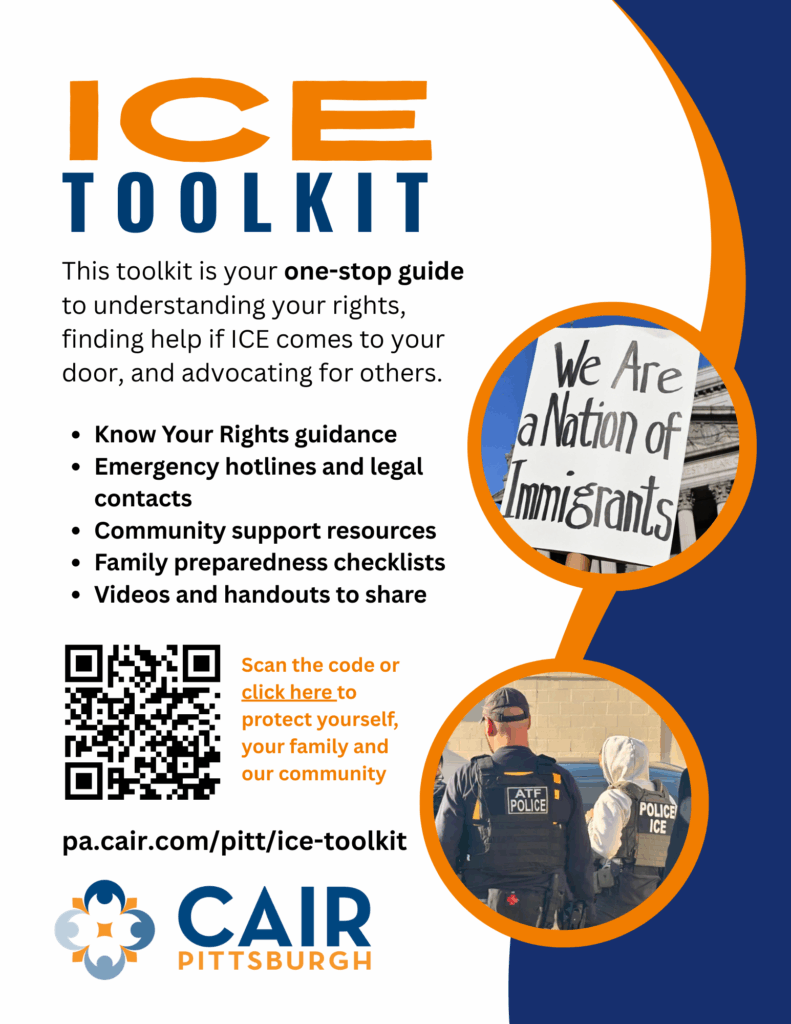
Share the webpage URL, the toolkit flier image (عربي, Harshen Hausa, русский, اردو, español), and/or the toolkit flier PDF.
Select Resources in Additional Languages
Currently Compiled Below:
عربي (Arabic)
Coming Soon:
Harshen Hausa, Русский (Russian), اردو (Urdu), Español (Spanish)
(FYI, there are some resources in the “coming soon” languages that are interspersed in the sections above, categorized by subject.)
أفضل الممارسات للمشاهدين العابرين (Bystander Best Practices)
الأمن الرقمي (Digital Security)
الدعوة (Advocacy)
قوائم التحقق وأوراق العمل التحضيرية (Preparation Checklists and Worksheets)
أشرطة الفيديو التعليمية: (Guidance Videos)
الحقوق القانونية (Legal Rights)
النماذج القانونية (Legal Forms)
دعم الترجمة (Translation Support)
إضافي (Additional)
You can help to sustain and expand our work by sharing our resources and donating to CAIR Pittsburgh.